
One Avoidable Reason Health Problems Sneak Up on Older Adults
You might feel fine, but if you’re sedentary, deleterious cellular juju is building up

THIS WEEK’S AGE WISE CRACK
Why should I act my age? Or more to the point, how is someone my age supposed to act?
—Dick Van Dyke, at 100 years old
Hey wise agers: Don’t miss Bits of Wisdom near the bottom of this newsletter, where you can read about the wanna-live-forever biohacker who’s developed an incurable disease, a woman’s take on how regrets ease with age, some anti-aging gummy baloney, and much more. Now let’s get into this week’s deep-dive feature story…

During much of our lives, work, family and other obligations might take precedence over physical activity. If we won the genetic lottery and lean into other healthy lifestyle factors, we might nonetheless feel just fine as the years go by. Until we don’t.
If only our lazy asses knew the evils brewing inside our bodies during all those years of sitting around.
“If you are 40, healthy, and sedentary, it is likely that you already have something going on inside your cells that will likely come back to haunt you in 10 or 15 years,” says University of Colorado researcher Iñigo San Millan, PhD.
Same goes for 41, 50, 60 or any stage of life, btw — cellular degradation knows no age limits.
In a new study, San Millan and colleagues used muscle biopsies to gauge how efficiently cellular mitochondria, the powerhouses inside almost all of our cells, burn fuel to create the energy that runs our bodies. The results:
Sedentary people lost mitochondrial function, which the researchers believe could precede the development of dementia, diabetes, cancer and other diseases. Compared to the active men, mitochondrial efficiency in sedentary individuals was lower across several categories.
During exercise, for example, the sedentary men accumulated 60% higher levels of lactate in their blood. Their blood levels of a protein called MPC1, key for turning glucose (the body’s main source of fuel) into energy, was 49% lower.
The results were published June 25 in the journal Clinical Bioenergetics.
‘Moving toward disease’
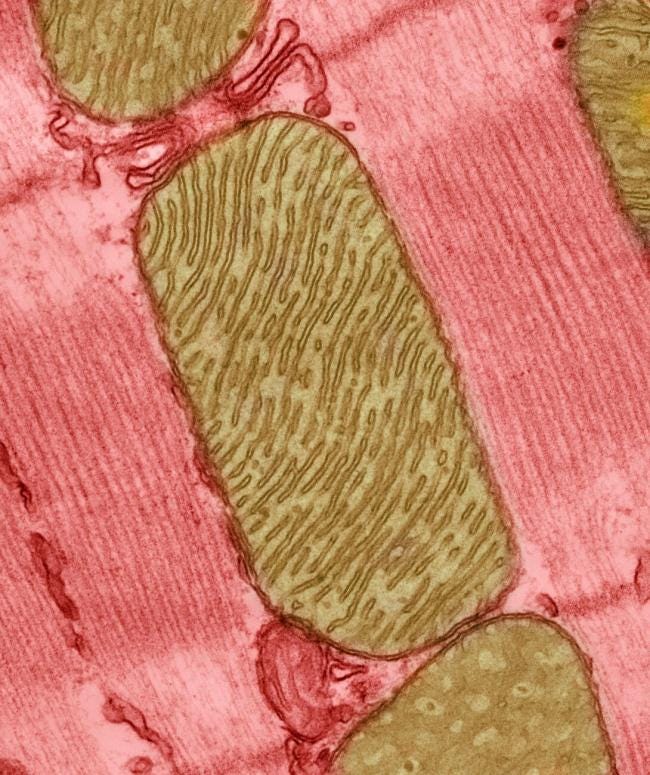
The research does not mean humans should not rest and relax. We definitely need downtime. It’s the prolonged sitting and lack of physical labor in the modern world that are eating away our insides. If you dig ditches or plumb houses for a living, or you dance regularly, or you’re an avid hiker or biker or gardener or chopper of wood, you can stop reading now.
But if your life cycles from couch to car to office and back, or otherwise doesn’t involve a lot of physical effort, please continue…
The mitochondrial findings by San Millan’s team suggest sedentary people are gradually losing the ability to generate the fuel vital for muscles, the brain and other organs. The effects are subtle and slow, largely imperceptible from day-to-day, even year-to-year, but persistent and apparently devastating over time.
“Being sedentary will progressively erode metabolic health,” says San Millan, an assistant professor of endocrinology, metabolism and diabetes at University of Colorado Anschutz. “When you stop moving, you lose that cellular identity of being healthy, and your body begins moving toward disease.”
The study was small, however, involving just 19 men around age 42, so additional investigation would be needed to confirm the results (a similar study on women is planned). Nevertheless, the findings align with what other researchers are learning about mitochondria, even though many mysteries remain, including how cause and effect play a role.
Mitochondrial dysfunction has been linked to many chronic diseases, from diabetes to dementia, cardiovascular disease to cancer, and it is known to generally increase with age.
“But is that because of aging, or because we stopped being as active as we get older? That’s often hard to separate out,” says Brian Glancy, PhD, a researcher at the National Institutes of Health who studies mitochondria in muscle.
A separate new study, analyzing activity and health data on 91,292 UK adults, linked lack of physical activity to cancer development (without shedding light on exactly why):
Each additional hour of prolonged, uninterrupted sedentary behavior in a person’s day is associated with a 9% higher risk of cancer death.
“Our findings suggest that the health effects of sedentary behavior may depend not only on total sedentary time, but also on whether that time is accumulated in prolonged bouts or interrupted by activity,” the study authors write this month in the journal PLOS Medicine. “This pattern is biologically plausible: experimental studies have shown that interrupting prolonged sitting with short bouts of activity can improve metabolic responses compared with uninterrupted sitting.”
(With cancer, a growing body of research finds the vast majority of cases have roots in lifestyle choices and environmental pollution, with lack of physical activity being just one of many possible contributing factors for a given person.)
The fix
Stacking the odds of healthy aging need not consume all your spare time. A mere 22 minutes daily can reap the bulk of the benefits of physical activity.
Any sort of physical activity is good for you and your future self, even if it’s just a few minutes here and there (it all adds up). And if you sit a lot, getting up every half-hour or so and moving about for as little as five minutes can be particularly protective.
Other experiments reveal very brief bouts of intense exercise — as little as a minute or two in the middle of a warm-up period—have a positive effect on mitochondria and lower blood pressure.
In fact, the evidence has grown considerably for the outsized benefits of exercise microdosing.
Even light physical activity — nothing more than normal movement like sweeping the floor or making the bed — is far more beneficial to health than once realized.
Movement, we’ve learned in recent years, is about the best insurance you can buy against chronic disease now and, importantly, later in life.
BITS OF WISDOM
Each week, I scour the interwebs in search of healthy aging news, inspirational stories, and utter BS …
Live forever? Bryan Johnson, an entrepreneur and social media influencer, spends some $2 million dollars annually trying to biohack his way to immortality. He takes dozens of daily supplements and employs multiple questionable technologies, making himself a giant biochemical experiment of one. He thinks it’s possible to live forever. Interestingly, last week Johnson announced he has autoimmune gastritis (AIG), an incurable though manageable disease. It’s a cautionary tale for anyone who dreams of immortality. Read the Age Wise news brief >>>
No regrets: As we age, we get better at dealing with regrets, or we simply have fewer of them. That’s the hope, anyway, and there’s some science to support the idea. One of my favorite writers, Kathleen Murphy, tells of a new study that supports the optimistic view. Importantly, she goes on to explain how to deal with regret, for those of us who struggle. Among the steps: Treat yourself with kindness and compassion, share your regrets so they’re not just bottled up, then move strategically forward. Her story is on Medium (the link works for non-members).
Baloney in a gummy: Earlier this week, USA Today published this: Hate taking pills? Meet the newest 'healthy aging' gummy supplement. The gummy is Fatty15, a brand that contains a product called C15:0, “a fatty acid that’s been linked to supporting long-term health at the cellular level,” the article claims. Don’t waste your money. The brand’s claims are based on research the manufacturer did. There’s no solid science behind the product, according to an analysis by Center for Science in the Public Interest, which adds: “Just because a company states something as a fact doesn’t mean that it’s true.”
Keep lifting! Former US soccer star Mia Hamm, now 54, still works out. She uses strength training, but not heavy weights anymore, to stay strong (something we all need to do as we age, lest natural muscle loss make us wimpy). “Her routine includes working out with resistance bands, lighter weights, and single-leg balance exercises, often with rotation, to improve classic longevity metrics like mobility, stability, and balance,” Business Insider reports. That’s a brilliant strategy for healthy aging — we need aerobic AND resistance work. Wait… Mia Hamm is 54?!
Lift this much: If you’re beyond your 30s and not challenging your muscles, they are slowly wasting away (it’s called sarcopenia, and it just happens). But it doesn’t have to be so. Strength training (weights, resistance bands or body-weight exercises like push-ups) is vital for healthy aging, to preserve mobility, capability and overall well-being. New research pins down how much is enough. Read the Age Wise news brief >>>
Love of language: Learning languages is among the ways to keep your mind sharp. New research adds an interesting twist. Scientists measured the brain's biological age among people who speak one language vs. people who speak two or more. The key finding: "... multilingual experience matters as a gradient: it is not simply about being bilingual or not, but about the depth and duration of language experience.” Read the Age Wise news brief >>>
Until next time, age wise.
Rob